
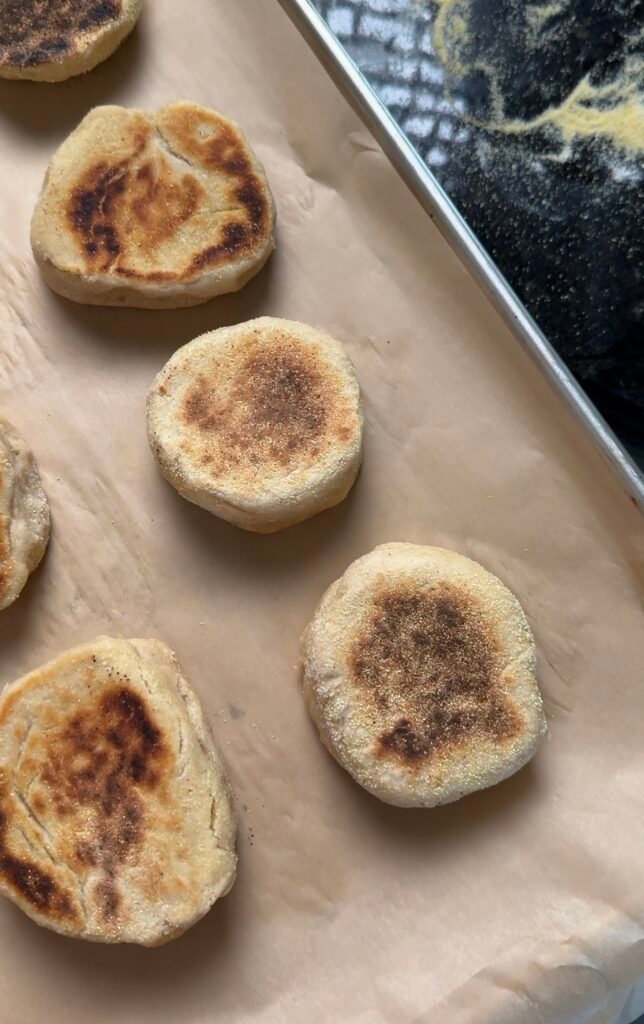
If you are still buying English muffins at the store, it is time for an upgrade. These Sourdough English Muffins are soft, chewy, and golden on the outside, with the gentle tang that only a sourdough starter can give. They are cooked in a cast iron skillet and then finished in the oven so the centers cook all the way through.
Homemade English muffins are one of those recipes that feels fancy but is surprisingly simple. You mix a soft dough with your active starter, water, honey, bread flour, a little butter, and salt, give it a few gentle stretch and folds, let it rise, then cook the muffins in a cast iron skillet on low heat. Nothing fancy is needed, only a skillet and an oven.
Whether you split them and toast them with butter and jam, or turn them into breakfast sandwiches, these muffins are a wonderful way to use your sourdough starter for more than just loaves. If you are building out your sourdough baking, they pair well with my Classic Sourdough Bread and Sourdough Ciabatta.
Here is what you need for the dough:
Flour swap: All-purpose flour will work, but the muffins will be a little less chewy. You may want to start with a bit less water.
In a large bowl, combine 240 grams of active starter, 240 grams of water, 5 grams of honey, 365 grams of bread flour, 2 tablespoons of softened butter, and 5 grams of salt. Mix until a soft dough forms.
Cover the bowl and do 3 sets of stretch and folds, about 30 minutes apart. To fold, grab one edge of the dough, gently stretch it up, and fold it over the center. Rotate the bowl and repeat all the way around.
Cover the dough and let it bulk ferment for 6 to 12 hours, depending on the temperature of your room, until it grows about 50% in volume. Watch the dough instead of the clock, and look for a puffy, slightly bubbly dough.
Gently shape the dough into a long roll. Cut the roll into circles and shape each one into an English muffin. This makes 8 to 10 English muffins: 8 for larger muffins, or 10 for smaller ones. Gently flatten both sides of each muffin in cornmeal.
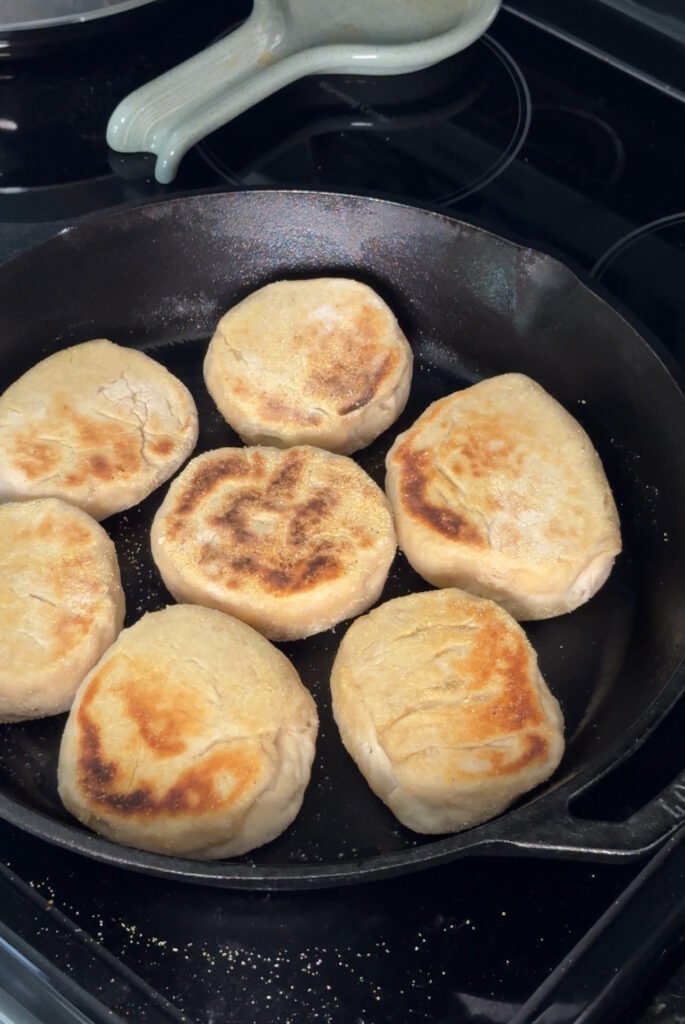
Heat a cast iron skillet over low heat. Place the muffins in the skillet and cook for about 4 minutes on each side.
Transfer the muffins to a baking pan and bake at 350°F for 10 minutes to cook the centers all the way through.
Let the muffins cool on a wire rack before splitting. For the best texture, split them with a fork instead of cutting them with a knife.
Pro Tip: Splitting with a fork pulls the muffin apart along its natural airy pockets, which gives you a rougher, more craggy surface to catch melted butter.
Store cooled English muffins in an airtight container or bag at room temperature for 2 to 3 days. For longer storage, split them first, then freeze them in a freezer-safe bag for up to 3 months. Toast them straight from frozen.
The skillet gives the muffins their golden, toasty outsides, and the oven finish makes sure the centers cook through without burning the outsides.
Yes, but bread flour gives a chewier texture. If you use all-purpose, you may want to start with a little less water.
Your starter should be bubbly, risen, and smell pleasantly tangy. This is usually 4 to 8 hours after feeding, depending on the temperature of your kitchen.
A fork follows the natural air pockets in the muffin and gives you a craggier surface, which toasts up with lots of crispy edges.
Yes. Split them, place them in a freezer-safe bag, and freeze for up to 3 months. You can toast them straight from the freezer.
Estimated using King Arthur Unbleached Bread Flour, 240 g of a 100% hydration starter, 5 g of honey, and 2 tablespoons of unsalted butter. Sodium comes from the salt only. Values vary with your ingredients and muffin size.
Homemade sourdough English muffins take a little planning, but the result is so much better than anything from a package. Once you make a batch, you will want to keep a stash in the freezer for slow mornings and quick breakfast sandwiches.
Cooking to nourish the body and serve with joy. Viky
Soft, chewy sourdough English muffins cooked in a cast iron skillet and finished in the oven for golden tops and fully cooked centers.
Estimated using King Arthur Unbleached Bread Flour, 240 g of a 100% hydration starter, 5 g of honey, and 2 tablespoons of unsalted butter. Sodium comes from the salt only. Values vary with your ingredients and muffin size.


