

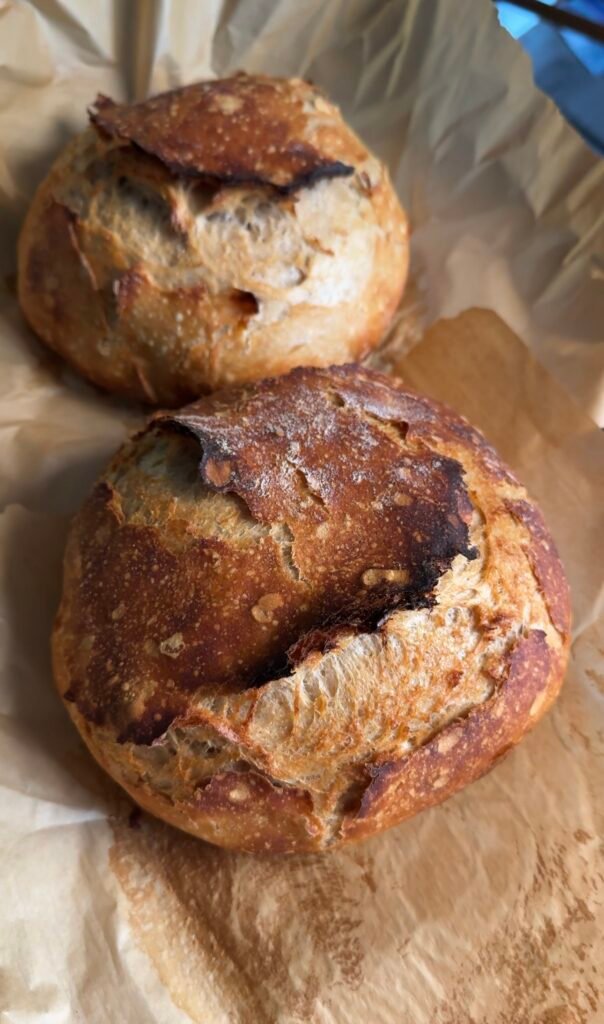

If you have been wanting to bake real sourdough at home but the process feels intimidating, this Classic Sourdough Bread is the perfect place to start. It uses just six ingredients, there is no kneading involved, and the Dutch oven does most of the work for you. The result is a loaf with a deep golden, crackly crust and a soft, chewy, tangy crumb.
This recipe blends bread flour with a little whole wheat flour, which adds a nutty, wholesome flavor and a bit of extra fiber without making the loaf heavy. A touch of raw honey helps feed the fermentation and rounds out the tang, and a gentle series of stretch and folds builds structure in place of kneading.
Sourdough is mostly about patience, not skill. Once you understand the rhythm of mixing, folding, and watching the dough grow, you can make a bakery-quality loaf in your own kitchen with simple, real ingredients.
Why You’ll Love This Classic Sourdough Bread
- No Kneading: A simple mix and a few stretch and folds build all the strength this dough needs.
- Only 6 Ingredients: Water, honey, active starter, whole wheat flour, bread flour, and salt.
- Bakery-Style Crust: Baking in a covered Dutch oven traps steam for a crisp, blistered crust and a tall rise.
- Flexible Schedule: The bulk ferment can run anywhere from 6 to 12 hours, depending on room temperature, so the dough works around your day.
- Wholesome Flavor: The whole wheat adds depth and a subtle nuttiness that pairs beautifully with the natural tang.
Classic Sourdough Ingredients & Substitutions
Here is what you need and why each ingredient matters:
- Water (395 grams): This is a higher-hydration dough, so the loaf bakes up open and tender. About 395 grams of water to 500 grams of flour comes to roughly 79% hydration, not counting the water in your starter.
- Raw Honey (5 to 10 grams): A small amount gives the yeast and bacteria a little extra food and softens the flavor. I use local raw honey. Pure maple syrup is an easy swap.
- Active Sourdough Starter (75 to 100 grams): Use a starter that is bubbly, risen, and at its peak. More starter means a faster rise, and less starter means a slower, tangier ferment.
- Whole Wheat Flour (150 grams): About 30% of the flour. It adds flavor, fiber, and nutrients. I use King Arthur Whole Wheat Flour.
- Bread Flour (350 grams): The higher protein content gives the loaf its chewy structure and good rise. I use King Arthur Unbleached Bread Flour.
- Salt (12 grams): Salt controls fermentation and brings out the flavor of the grain. Fine sea salt dissolves easily into the water.
Flour swap: If you would like to use all bread flour, go ahead, but hold back a little of the water at first. Whole wheat flour absorbs more liquid, so a dough made with only white flour can feel looser.
How to Make Classic Sourdough Bread Step-by-Step
1. Mix the Dough
In a large bowl, add the 395 grams of water, 5 to 10 grams of raw honey, 12 grams of salt, and 75 to 100 grams of active starter. Stir until the starter and honey are mostly dissolved.
Add the 150 grams of whole wheat flour and 350 grams of bread flour. Mix until no dry flour is left, but do not knead. The dough will look shaggy and rough, and that is exactly what you want.
2. Rest, Then Stretch and Fold
Cover the bowl and let the dough rest for 30 to 60 minutes. Then do your first set of stretch and folds: grab one edge of the dough, gently stretch it up, and fold it over the center. Rotate the bowl and repeat all the way around.
Continue with 2 to 3 more sets of stretch and folds over the next 2 hours, spacing them out as the dough relaxes. By the end, the dough will be soft but will hold its shape much better than when you started.
Pro Tip: Wet your hands with a little water before each fold. It keeps the dough from sticking to you and makes the folds much easier.
3. Bulk Ferment
Cover the dough and leave it at room temperature until it grows about 50% in size. This takes roughly 6 to 12 hours, depending on the temperature of your room. In a warm house it will be on the shorter end. In a cooler kitchen, or if you want a more developed, tangier flavor, it can go longer.
Watch the dough instead of the clock. You are looking for a puffy, jiggly dough with some bubbles on the surface and around the edges.
4. Final Proof, then Shape and Prepare to Bake
Turn the dough out onto a lightly floured surface. Take each of the four ends and fold each one over the other side. Flip the dough over so the folded seams are on the bottom and you have a smooth, rounded top. Gently cup the sides and rotate in a circular motion to tighten the shape. The goal is to build surface tension to create a tight ball. Let the shaped loaf sit and warm up on the counter while your oven preheats. This is the final proofing process and you can wait to start the oven as final proofing should take 2-4 hours.
Preheat your oven with the Dutch oven inside to 500°F for 45 to 60 minutes. A very hot Dutch oven helps the loaf rise tall and gives you a crisp crust.
Right before baking, score the top of the loaf with a sharp knife or bread lame. Then carefully place the dough in the hot Dutch oven. Use sturdy oven mitts, because the pot will be extremely hot.
5. Bake in a Dutch Oven
Put the lid on and bake at 500°F covered for 25 to 30 minutes. The lid traps steam, which keeps the crust soft long enough for the loaf to rise fully.
Lower the oven temperature to 450°F, remove the lid, and bake uncovered for another 25 to 30 minutes, until the crust is deep golden brown.
6. Cool Completely
Transfer the loaf to a wire rack and let it cool before slicing. The inside is still setting as it cools, and cutting too early can give you a gummy crumb. It is hard to wait, but it is worth it.
Tips for the Best Sourdough Loaf
- Use a Strong, Active Starter: Feed your starter ahead of time and use it when it is bubbly and at its peak. A sluggish starter makes for a dense loaf.
- Judge by Volume, Not Time: Your kitchen temperature changes everything. Look for the 50% rise instead of following the clock strictly.
- Don’t Add Extra Flour: This dough is meant to be soft and a bit sticky. Wet hands, not more flour, are the answer.
- Make It Work for Your Day: Mix in the morning and bake in the evening, or let the bulk ferment run longer for more flavor.
- Trust the Dutch Oven: The covered bake is what gives you that bakery-style rise and crackly crust.
How to Store Sourdough Bread
Store your cooled loaf cut-side down on a cutting board, or in a bread bag or cloth, at room temperature for 2 to 3 days. To keep it longer, slice the loaf and freeze the slices in a freezer-safe bag for up to 3 months. Toast slices straight from frozen.
Frequently Asked Questions
How do I know when my sourdough starter is ready to use?
Your starter should be bubbly, noticeably risen, and smell pleasantly tangy. This is usually 4 to 8 hours after feeding, depending on the temperature of your kitchen.
Do I have to knead this sourdough?
No. The stretch and folds build the gluten structure for you. You mix until there is no dry flour, rest the dough, and fold it a few times over about 2 hours.
How long should I let my sourdough bulk ferment?
Until it has grown about 50%. This usually takes 6 to 12 hours, depending on the temperature of your room. In a warm kitchen it will be on the shorter end, and in a cooler kitchen, or for extra flavor, it can take longer.
Why bake sourdough in a Dutch oven?
The covered pot traps steam released by the dough, which helps the loaf expand fully and creates a crisp, crackly crust. Removing the lid for the second half browns the crust.
Can I use all bread flour instead of whole wheat?
Yes. You may want to start with a little less water, since white flour absorbs less than whole wheat.
Nutrition Information (Full Loaf & Per Slice)
- Full Loaf Totals: ~1,970 Calories | 73g Protein | 412g Carbs | 28g Fiber | 4g Fat
- Per Slice (12 Slices): ~165 Calories | 6g Protein | 34g Carbs (32g Net) | 2g Fiber | less than 1g Fat | ~390mg Sodium
Estimated using King Arthur Unbleached Bread Flour and King Arthur Whole Wheat Flour, 7.5 g honey, and 87.5 g of a 100% hydration starter. Actual values vary with your flour, starter amount, and how thick you slice.
A Loaf Worth the Wait
Homemade sourdough takes a little time, but most of it is hands-off. With a few simple ingredients and some patience, you end up with a loaf that tastes better than anything off a store shelf. Once you master this classic recipe, you can use it as the base for countless variations.
Looking for more sourdough ideas? Try my [Sourdough Ciabatta], [Sourdough English Muffins], and [Sourdough Focaccia]. [ADD INTERNAL LINKS WHEN THESE POSTS ARE LIVE]
Cooking to nourish the body and serve with joy. Viky
Classic Sourdough Bread (Easy Dutch Oven Recipe)
A no-knead classic sourdough loaf made with whole wheat and bread flour, bubbly starter, and a touch of honey, baked in a Dutch oven for a crackly crust.
Ingredients
Instructions
-
In a large bowl, add 395 grams of water, 5 to 10 grams of raw honey, 12 grams of salt, and 75 to 100 grams of active sourdough starter. Stir until the starter and honey are mostly dissolved.
-
Add 150 grams of whole wheat flour and 350 grams of bread flour. Mix until no dry flour is left, but do not knead. The dough will look shaggy and rough.
-
Cover the bowl and let the dough rest for 30 to 60 minutes. Then do the first set of stretch and folds: grab one edge of the dough, gently stretch it up, and fold it over the center. Rotate the bowl and repeat all the way around.
-
Continue with 2 to 3 more sets of stretch and folds over the next 2 hours, until the dough is soft but holds its shape much better than when you started.
-
Cover the dough and leave it at room temperature until it grows about 50% in size. This takes roughly 6 to 12 hours, depending on the temperature of your room.
-
Turn the dough out onto a lightly floured surface. Take each of the four ends and fold each one over the other side. Flip the dough over so the folded seams are on the bottom and you have a smooth, rounded top. Gently cup the sides and rotate in a circular motion to tighten the shape. The goal is to build surface tension to create a tight ball. Let the shaped loaf sit and warm up on the counter while your oven preheats. This is the final proofing process and you can wait to start the oven as final proofing should take 2-4 hours.
-
Preheat your oven with the Dutch oven inside to 500°F for 45 to 60 minutes.
-
Right before baking, score the top of the loaf with a sharp knife or bread lame. Carefully place the dough in the hot Dutch oven, using sturdy oven mitts.
-
Put the lid on and bake at 500°F covered for 25 to 30 minutes.
-
Lower the oven temperature to 450°F, remove the lid, and bake uncovered for another 25 to 30 minutes, until the crust is deep golden brown.
-
Transfer the loaf to a wire rack and let it cool completely before slicing.
Note
Nutrition: ~165 calories, 6 g protein, 34 g carbs, 2 g fiber per slice (12 slices)

